Combined company surpasses $110 million in annual revenue, marking early North American consolidation in a fragmented corporate dining market
ARLINGTON, VA / ACCESS Newswire / February 25, 2026 / HUNGRY, a workplace food platform serving more than 1,000 corporate clients across the United States, today announced it has merged with hungerhub, Canada’s leading office-meal delivery provider, in a cross-border transaction that lifts combined annual revenue above $110 million and expands operations across North America.
The deal comes as employers increasingly invest in workplace food programs to support return-to-office attendance, employee retention, and culture building, even as the corporate catering market remains highly fragmented across regional providers and logistics platforms.
“Our vision has always extended beyond a single market,” said Jeff Grass, CEO of HUNGRY. “By bringing hungerhub into the platform, we are expanding our ability to deliver consistent workplace dining experiences across borders while continuing to scale with our enterprise customers.”
HUNGRY has served more than 7 million meals to date and operates across 24 U.S. cities. The merger expands that geographic reach and deepens operational scale, strengthens technology infrastructure, restaurant partnerships, and multi-location corporate service capabilities. HUNGRY delivers catering, group order, live events, pantry, and micro-market solutions for enterprise workplaces, while hungerhub adds a technology-enabled ordering platform, a curated Canadian restaurant network, and established market expertise. Together, the companies position HUNGRY among the largest workplace food platforms in North America, signaling early consolidation in a category historically defined by local and regional providers that provide one service offering.
“Work has outgrown traditional boundaries,” said Gary Batara, chief marketing officer of HUNGRY. “This merger allows us to scale meaningful food experiences for organizations and people operating across cities and, now, countries.”
“Joining HUNGRY accelerates our mission to modernize the office meal experience while maintaining the quality our customers trust,” said Sari Abdo, CEO of hungerhub.
With more than 1,000 corporate clients and millions of meals served annually, HUNGRY plans to continue expanding geographically and investing in infrastructure that supports large, multi-location employers across North America. Hungerhub’s leadership, expertise, and restaurant partnerships will remain central to operations in Canada, ensuring continuity for clients while unlocking new opportunities for innovation.
About HUNGRY
HUNGRY is the workplace food platform organizations trust to deliver happiness and wellbeing. By combining culinary excellence, smart technology, and hospitality-driven service, HUNGRY helps companies simplify workplace dining while creating experiences employees value. Serving over 1,000 corporate clients, the company is building a platform designed for the future of work – where culture, connection, and care extend across every location teams call home.
About hungerhub
Based in Toronto and operating in over ten markets in Canada, hungerhub has been Canada’s leading workplace meal plan solutions since 2018. Connecting the workplace with a curated network of local restaurants for daily meal delivery through a technology-enabled ordering experience for daily delivery. Known for flexibility, personalization, and operational reliability, hungerhub helps organizations deliver modern food experiences that employees appreciate.
63% report higher RFP volumes – but up to 20% go unfinished due to resource constraints as proposal teams see 25 to 50% workload spikes
SEATTLE, WA / ACCESS Newswire / February 25, 2026 / As B2B buying has become more structured, consensus-driven and risk-averse, proposals and RFPs have moved from a back-office task to a primary driver of revenue at professional services firms, according to new research from QorusDocs, a leader in AI-powered value and proposal management software. Once viewed as a downstream support function, proposal management, now directly shapes pipeline health, win rates and revenue outcomes.
As AI disrupts the traditional billable-hour model and prompts corporate clients to question fees, proposal operations have emerged as a critical lever to protect margins and capture growth. However, growing RFP volumes have driven a 25 to 50% workload spike for proposal teams at most organizations.
“Time, not intent, has become the primary constraint for modern proposal teams,” said Ray Meiring, CEO of QorusDocs. “Organizations believe in formal pursuits and see clear revenue upside, but many simply can’t respond to everything that hits their desk-and that gap now shows up directly in revenue risk exposure.”
As a growing share of revenue decisions move through formal RFPs, inefficiency becomes a measurable business risk. Large deal sizes, intense competition and capacity limits collide, turning day‑to‑day proposal work into a C‑suite issue.
Key findings from the QorusDocs 10th Annual Proposal Management Survey
Proposal and RFP volume keep climbing. 68% of respondents reported year‑over‑year increases in proposals, and 63% said they responded to more RFPs. Most growing firms added 6-10 new proposals or RFPs per month, while the average response still takes 6-10 days and nearly a third (31%) say 21 or more people are regularly involved in responses. As a result, most organizations saw workloads spike between 25 and 50%.
RFPs are now a primary revenue gateway. More than four in five respondents (82%) said they win 25 to 75% of new business through RFPs, underscoring the central role formal responses play in revenue generation. A majority said at least half of both new and existing client sales come from winning RFPs, meaning proposal effectiveness now governs how much revenue firms are even eligible to capture.
Value proof is now table stakes. Almost 90% of respondents say including ROI or business cases is important to their proposal process, reflecting buyers’ demand for clear, quantified outcomes rather than generic capabilities.
AI is delivering efficiency – but adoption is uneven. 73% of organizations have automated at least a quarter of their proposal process, and 29% have automated at least half, yet 28% still have little automation in place. For 60% of organizations, AI enables greater response volume, while 35% already credit AI with higher win rates and revenue.
Capacity gaps put millions in revenue at risk. Most organizations are unable to respond to between 10 and 20% of incoming RFPs due to time or resource constraints. Given typical volumes and deal sizes, missing just one response per month can expose teams to an estimated $1.2 million to $60 million in potential annual revenue loss.
Execution, not content creation, is the main bottleneck. Top pain points include SME delays (48%), time spent locating and maintaining content (46%) and responding on time (42%), followed closely by personalization (41%) and the lack of a centralized content solution (40%). More than a quarter say measuring effectiveness remains elusive, making it hard to know which messages and content actually drive wins.
Proposal work happens in Microsoft software. Most organizations still rely on Microsoft tools like Word (53%), PowerPoint (18%) and Excel (11%) to draft proposals, reflecting deep-seated workflows that demand integrated automation – not new tools – to coordinate across large teams, govern content and enable reuse at scale more efficiently.
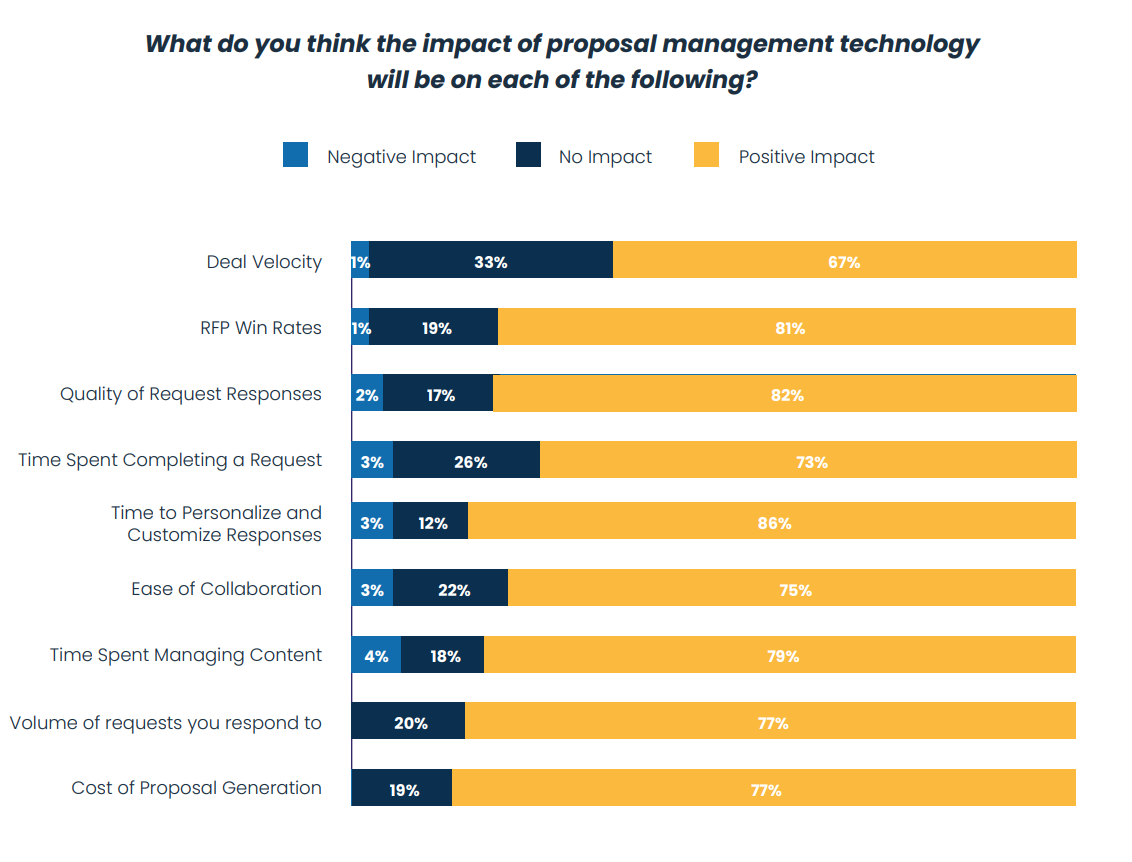
Expectations for proposal AI and automation are sky-high. 81% of respondents expect proposal management software to lead to higher RFP win rates, while 73% expect to complete requests faster, 67% anticipate faster deal velocity, and 77% expect lower proposal generation costs. In terms of process, 86% expect AI to improve the time required to personalize and customer RFP responses, while 82% anticipate improvements in response quality and 79% expect reduced time spent managing content.
“The next phase of proposal work won’t be defined by who uses AI, but by who turns AI into a coordinated system,” Meiring added. “Firms that integrate AI across people, content and process will be able to scale without scaling risk; those that treat it as a bolt‑on feature will hit a ceiling.”
About the Research
The QorusDocs 10th Annual Proposal Management Survey is based on a survey of 297 professionals involved in proposal creation, RFP responses, and proposal management software decisions at organizations with 100 to 5,000+ employees. Respondents span professional services (26%), legal services (24%), architecture, engineering, and construction (20%), IT services (19%) and financial services (4%), reflecting the day‑to‑day realities of proposal‑driven teams across multiple industries.
Click here to download the QorusDocs 10th Annual Proposal Management Survey.
About QorusDocs
QorusDocs is an automated Value and Proposal Management platform that unites value management with proposal automation. Built for professional services, legal, technology services and AEC organizations, the platform supports intelligent business cases and personalized, data driven pitches, presentations, proposals and RFP responses. Trusted by more than 200 organizations, QorusDocs helps firms prove ROI, optimize billable hours, and win more business. The company operates globally, with offices in Bellevue, Washington, London, England and Cape Town, South Africa.
83% of tech recruiters believe company success is more dependent on upskilling employees for AI versus hiring new talent, according to The State of Tech Talent 2026
NEW YORK CITY, NY / ACCESS Newswire / February 25, 2026 / Nearly all technology recruiters (96%) say technical roles are still at least a bit difficult to fill, as most (83%) believe their company’s success is now more dependent on upskilling their existing employees for AI rather than hiring external talent, according to The State of Tech Talent 2026, the fourth annual report from AI training provider General Assembly, an LHH brand.
“The AI skills gap is growing too fast for companies to hire their way out,” said Daniele Grassi, CEO of General Assembly. “Continuous, incremental and role-specific learning is the only way to keep up with the pace of technology change. Growing investment in upskilling reflects leaders’ realization that their existing employees bring the business context, institutional knowledge and cultural navigation skills that can be supercharged with AI.”
The State of Tech Talent 2026 report is based on a survey of 500 talent acquisition professionals who hire technology talent in the U.S., U.K. and Singapore. It found that companies increasingly embrace upskilling as a talent development strategy as they seek to build AI-forward workforces and in light of the growing costs related to recruiting and visas.
Key Findings
Tech hiring is still tough: Of recruiters who found it extremely difficult to fill tech roles this past year, nearly half (47%) report that data analytics and data science roles are the hardest to fill, followed by software engineering (38%). Additionally, 95% of tech recruiters said they are considering or already taking steps to source more visa-independent talent over the next year.
Upskilling is the path forward: In 2026, 80% of tech recruiters believe upskilling will play a major or huge role in filling talent gaps. Already, 35% of companies are more likely to train existing employees when they need more tech talent, compared to 28% in 2024. And nearly half (47%) anticipate adding or offering upskilling programs and data analytics and data science, while about two in five expect to offer upskilling programs for AI development (43%) and AI literacy (42%).
Training methods vary. While nearly two in five (39%) HR professionals believe on-the-job training is the most effective upskilling method, opinions varied. More than one-third preferred paying for employees to attend external training or certifications (36%) or working with an external partner to develop customized training or certifications (34%).
Measuring success. More than two-thirds of companies (68%) turn to performance-based indicators such as improvements in key metrics or manager assessments to determine the effectiveness of upskilling and training programs. Half have also used pre- and post-test assessments (50%) or attainment of industry certifications or degrees (49%). However, 43% of respondents also said they struggle to measure the benefits of training.
Barriers to training. In addition to measurement challenges, half of HR respondents said that not having enough time (47%) or budget (46%) keep them from training employees. But for 36%, low employee participation or buy-in prevents companies from investing further in training. Companies with fewer than 2,500 employees were most likely to face lack of buy-in from leadership (37%, compared to 24% at larger companies).
Recruiters themselves fear job loss. Half of tech recruiters (50%) fear the recruiter role will be obsolete within five years, while 61% report they have already seen some of their entry-level jobs automated out of existence (and 32% believe it’s coming).
To download the full State of Tech Talent 2026 report, click here.
Methodology
General Assembly and Wakefield Research surveyed 500 human resources professionals with a minimum seniority of manager who work in talent acquisition at companies hiring technology talent in software engineering, data analytics, data science, and UX roles in the U.S., U.K., and Singapore markets. Surveys were conducted between Oct. 29 and Nov. 9, 2025, using an email invitation and an online survey. Data has been weighted.
About General Assembly
General Assembly (GA), an LHH brand, is the leading talent and upskilling partner that helps individuals and businesses acquire the real skills required to succeed in an increasingly complex technological era. Founded in 2011 to make tech-centric jobs accessible to anyone and meet the demand of fast-growing tech companies, GA evolved into a center of excellence in training people from all backgrounds to upgrade their practical knowledge of tech skills now required in every company and in any role. With a global presence, hands-on instruction, and a passionate alumni community, GA gives learners 360-degree support as they take the next step in their career journey. General Assembly is part of LHH, the professional talent solutions arm of The Adecco Group, the world’s leading talent advisory and solutions company. GA matches the right talent to business needs. All day, every day: GA puts real skills to work.
CLEVELAND, OHIO / ACCESS Newswire / February 25, 2026 / Poet Anthony Andricks will release The Age of Something Other Than Reason on March 10, a bold poetry collection structured like a play in three acts and an intermission. The book stages a sharply theatrical examination of contemporary American culture shaped by social media, misinformation, ideological extremism, advancing technology, and algorithm-driven outrage.
The Age of Something Other Than Reason
Its three primary acts move fast and hit hard, documenting technological, political, religious, and psychological systems that reward loyalty over reflection. Throughout the book, journal entries from a once-human artificial intelligence reflect on America’s collapse into factional thinking, documenting the moment when farce and delusion overtook sanity and logic.
“I’m not preaching, I’m documenting,” Andricks says. “I took a timed snapshot of modern American culture using my own creative filter, but as an American, I am also one of the subjects standing within that frame of observation.”
Midway through, Andricks interrupts the chaos with a formal Intermission – a conscious pause for poems about travel, nature, independence, and human connection, reminding readers what exists beyond the noise and what risks being lost to it.
Pop poetry that meets the times, The Age of Something Other Than Reason is heralding without being prescriptive and accessible without sacrificing depth. This book is the follow-up to Andricks’ 2024 chart-topping poetry collection Repurposed (Trial by Lineation). Like Repurposed, this book also features artwork by Cory Andricks, the author’s brother.
Anthony Andricks grew up in Bryan, Ohio, and presently resides in Lakewood, Ohio. Anthony graduated summa cum laude from Cleveland State University College of Law in 2012 and currently practices commercial real estate law at a national law firm headquartered in downtown Cleveland, Ohio. When not working or writing, Anthony enjoys international travel, challenging hikes, horror movies, and local art exhibitions.
SAN BERNARDINO, CALIFORNIA / ACCESS Newswire / February 25, 2026 / Dateline Resources Limited (ASX:DTR)(OTCQB:DTREF)(FSE:YE1) (Dateline or the Company) is pleased to report on the interpretation of the Company’s high-resolution geophysical datasets collected across the Colosseum Project. Gravity, high-resolution airborne magnetics and radiometrics, induced polarization (IP) and magneto-tellurics (MT) were interpreted with geological mapping and surface geochemistry data to identify carbonatite rare earth targets. Three distinct targets demonstrate coincident anomalies that would be expected from a carbonatite source. Two of the targets are defined sufficiently for a diamond drill program.
In addition, drilling in late 2025 (RC25-038) delivered the first drill-based confirmation of mantle-derived anomalous rare earth elements (REE) at the project. This drill hole was completed before the new infill geophysics surveys, with the hole interpreted to have intersected the margin of Target 1. Assaying shows a geochemical fingerprint that points clearly to a mantle-sourced carbonatite system.
Highlights
Converged Geophysical and Geological Datasets: Multiple high-resolution datasets have been collected, processed and interpreted together for the first time, providing a comprehensive view of the project.
Rare Earth Elements (REE) halo intersected in drilling: Drillhole RC25-038, on the margin of Target 1, intersected anomalous rare earth elements, representing the first drill-based confirmation of sub surface REE at the project.
Mantle-Derived REE System Confirmed: The REE signature in RC25-038 is mantle-derived and is directly comparable to the Mountain Pass carbonatite system.
Carbonatite-Style Geochemical Signature Identified: RC25-038 returned elevated Ba, Sr, Ca, P, Th and U with associated potassic alteration, confirming proximity to an alkaline-carbonatite source.
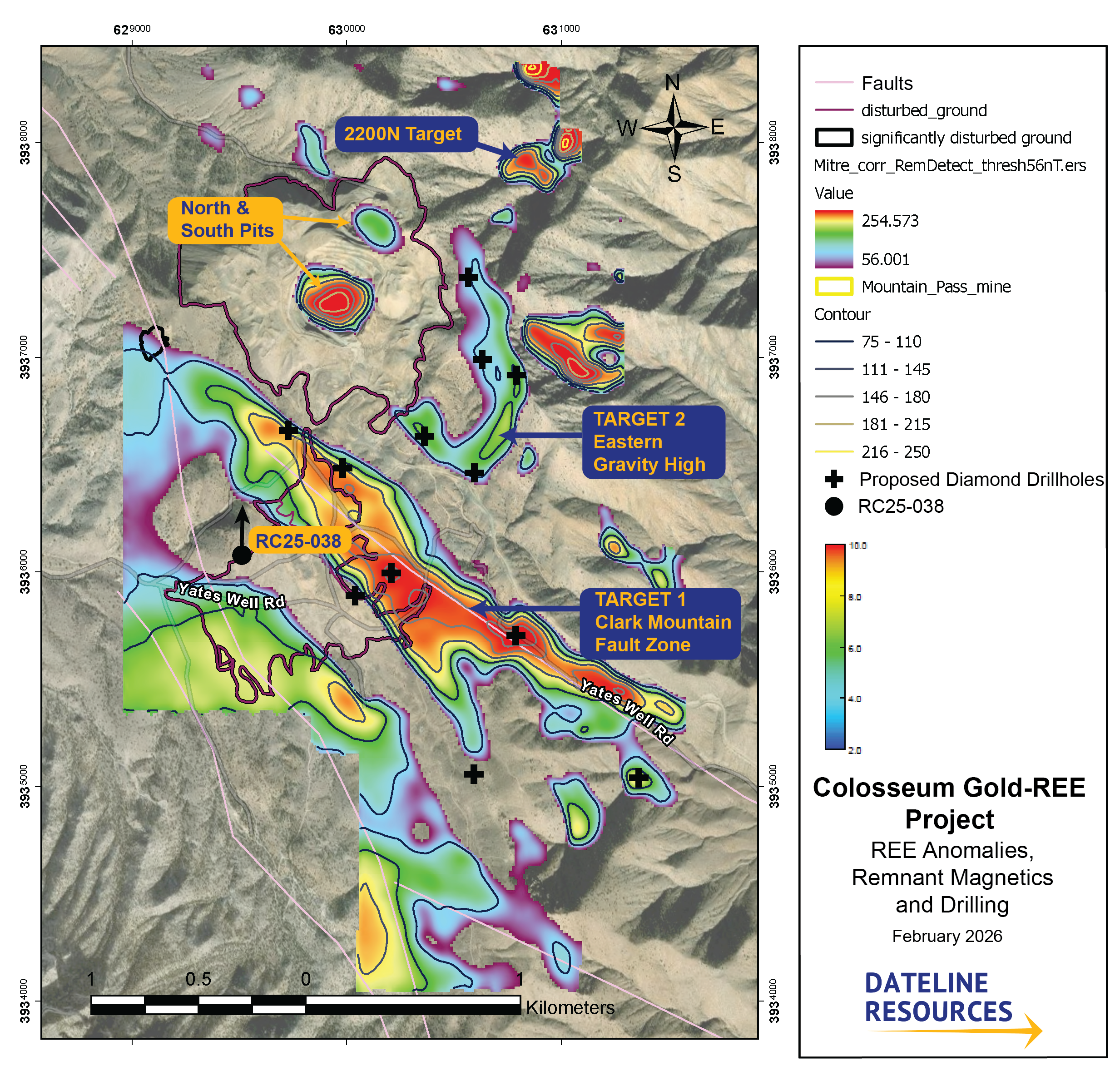
Carbonatite Diamond Drilling: Twelve drillhole locations have been finalized to test the Clark Mountain Fault Zone (Target 1) and Eastern Gravity (Target 2) anomalies.
Dateline’s Managing Director, Stephen Baghdadi, commented:
“The completion of the integrated high-resolution datasets has given us a level of confidence in our targeting that we have not had before. Two well-defined targets, twelve holes, and a third zone in the 2200N anomaly that we are continuing to work on. We are advancing this project methodically and the technical foundations are strong.
“Importantly, RC25-038 is an important result, being the first drill-based confirmation of rare earth elements at Colosseum. It carries additional weight, given where it sits on the margin of what is now our highest-priority carbonatite target.”
Combined Datasets Provide a Clearer Picture Than Ever Before
The full suite of geophysical surveys carried out at the Colosseum Project, together with the geochemistry data collected in 2025, has now been brought together and interpreted as a collective dataset for the first time.
Previous announcements described each survey’s result individually. Combining them has identified where signals from completely different techniques, each measuring something unique about the ground beneath the surface, all converge at the same location. When multiple independent methods coincide, the confidence in a target increases significantly. No single survey could provide this level of granularity and clarity on its own.
Importantly, the geochemical results from drill hole RC25-038 (see further in this announcement) and historical surface sampling have also been brought into this combined analysis, allowing the geophysical models to be ground-truthed against real geochemistry.
Figure 1: Carbonatite Targets at Colosseum highlighted by remnant magnetics image. Drillhole RC25-038, drilled in the tailings dam area is shown as a circle, with the 12 planned diamond drillholes shown as crosses in the figure.
Target Areas Combined and Refined
The combined interpretation has refined three distinct areas of REE-carbonatite interest at Colosseum. Two, the Clark Mountain Fault corridor and the Eastern Gravity High, are defined clearly enough to progress drilling immediately. The 2200N anomaly, identified in earlier MT survey work, is being further assessed for drilling after this program.
Target 1: Clark Mountain Fault Zone (Primary REE-Carbonatite Target)
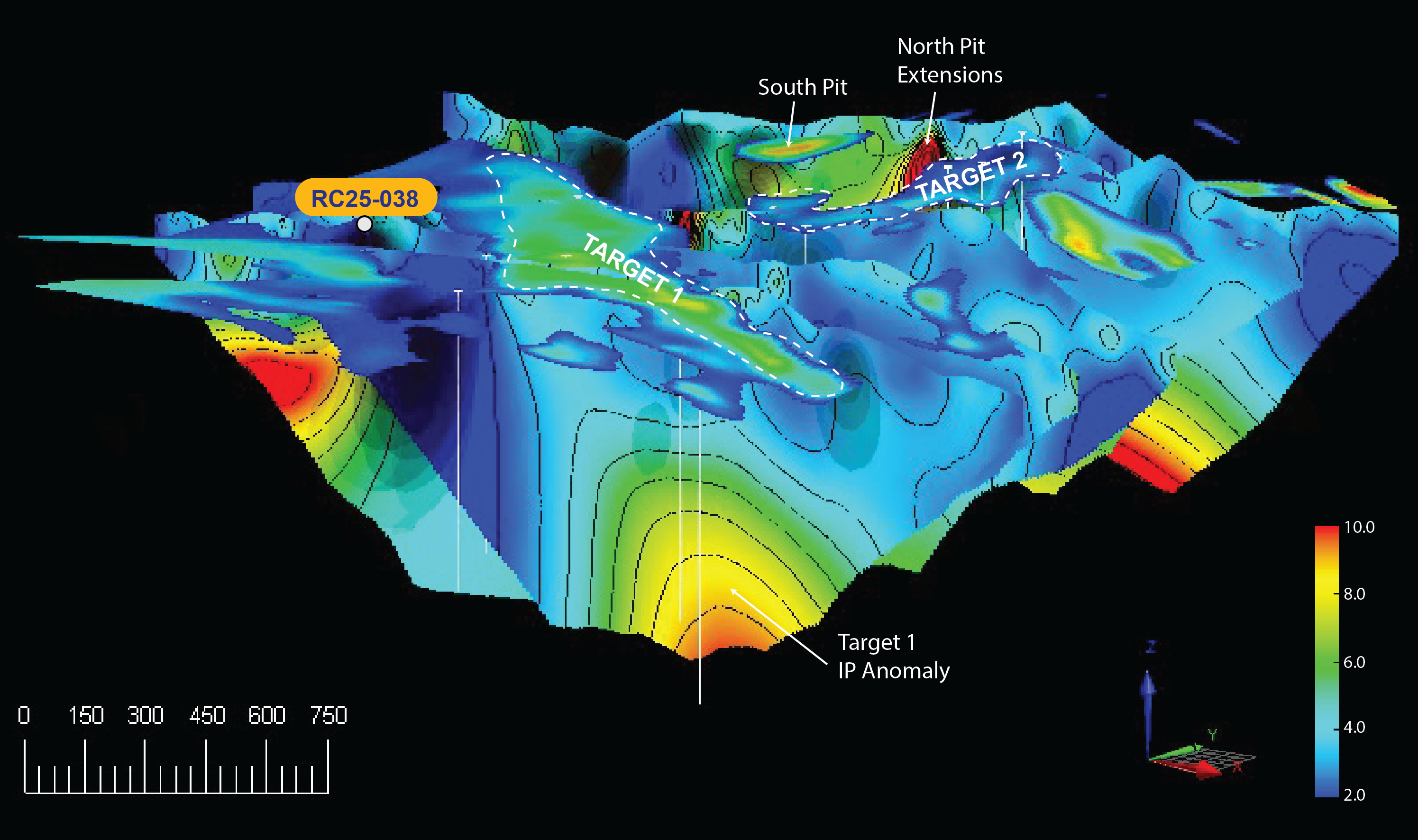
Target 1 is interpreted as a NW bearing structure that is approximately 1.2km long and between 150-200 meters wide and follows the Clark Mountain Fault. The scale and converging datasets make this the highest-priority REE-carbonatite target. It stands out because every survey type has anomalies that coincide:
The electrical surveys (IP and MT) indicate conductive and chargeable material at depth along the fault;
The radiometricsshow elevated potassium and thorium, elements commonly enriched around carbonatite bodies;
The gravitysurvey shows a high-density body of rock at depth consistent with a carbonatite intrusion and
Surface and subsurface geochemistryshows elevated levels of rare earths, barium, strontium, calcium and phosphorus, all of which are hallmarks of carbonatite-related mineralization.
The IP, MT and gravity responses are similar to that seen at Mountain Pass, 10km to the south.
Target 1 is further strengthened by drill hole RC25-038 (described below), which sits on the eastern edge of this target area and confirmed rare earth elements downhole at around 40 meters depth. The REE-bearing rock unit intersected in RC25-038 appears to get wider as it goes deeper. With the benefit of all the merged data, new drill holes at Target 1 are positioned deeper and closer to the center of the anomaly than RC25-038.
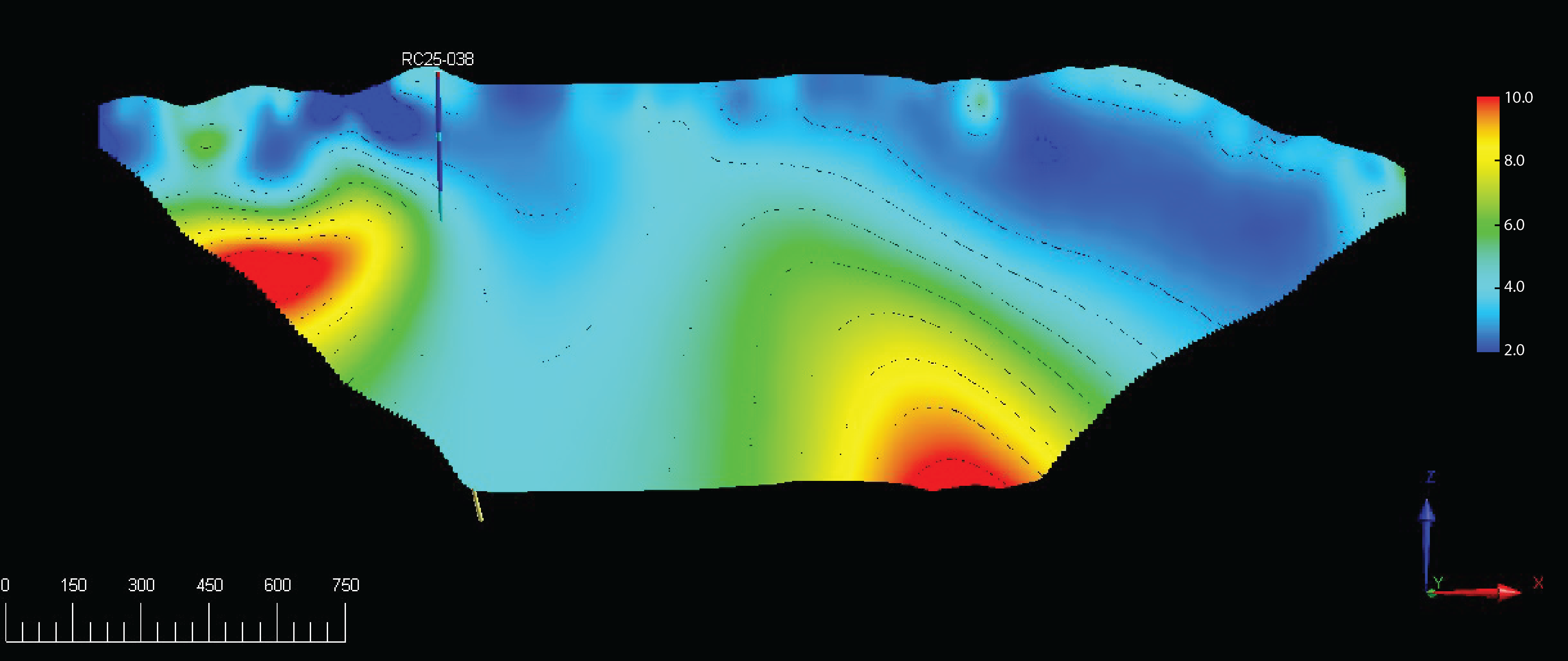
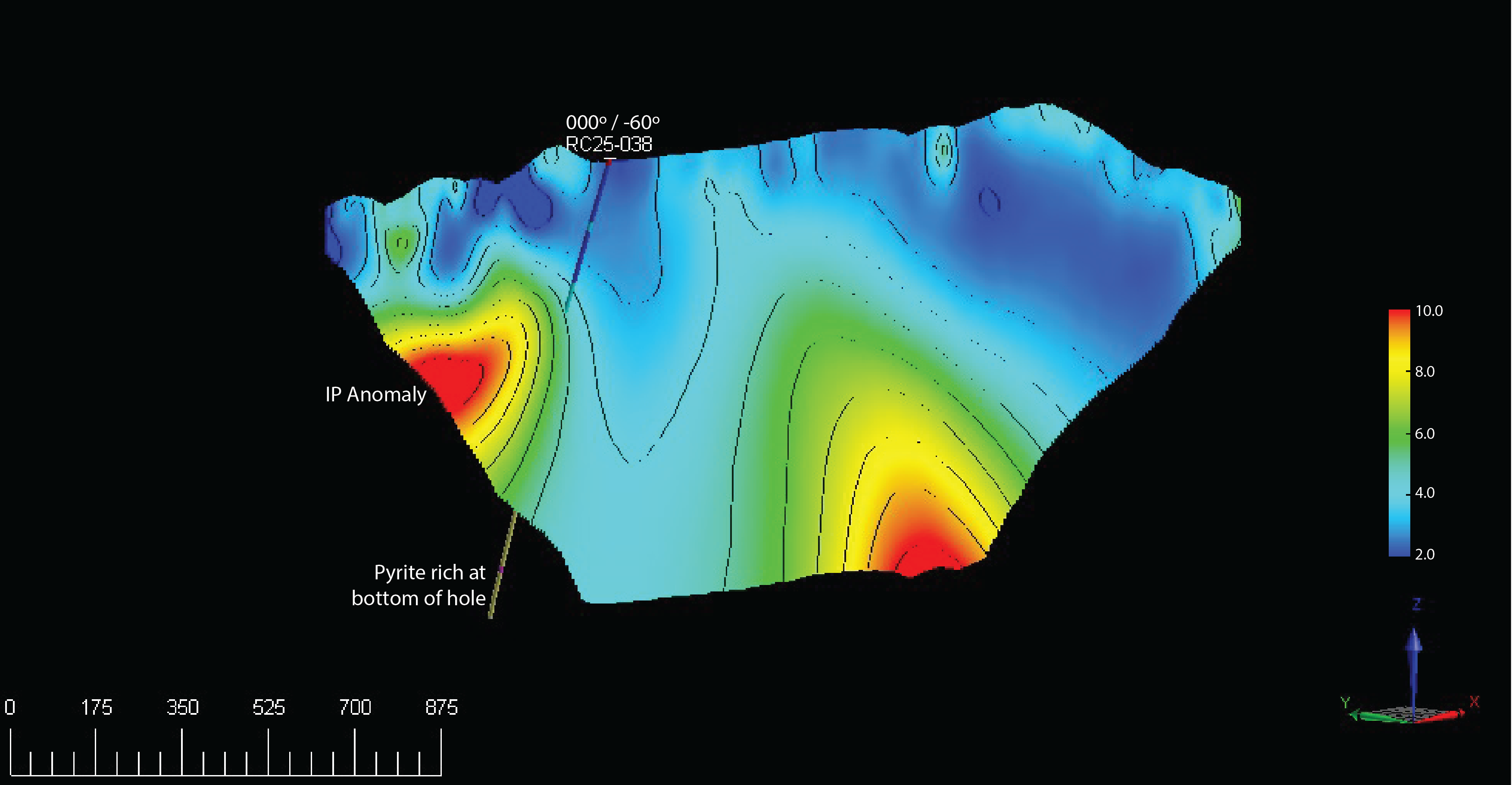
Figure 2: East-West IP chargeability cross section showing hole RC25-038, drilled true north into the section.
Target 2: Eastern Gravity High
Target 2 is defined by a strong gravity anomaly on the eastern side of the Colosseum claim area, running roughly north-south in a ring-like structure. The gravity and electrical survey data both suggest a dense resistive body of rock buried at depth, the same kind of signal associated with carbonatite intrusions. The drill target sits west of extensive mantle derived outcrops at surface and a geochemistry carbonate anomaly at surface.
Target 3: 2200N Anomaly
The 2200N anomaly remains a high-priority target. The MT resistivity and IP chargeability responses are both exceptionally broad in lateral extent, and additional modelling is required to identify the optimal drill entry points before committing capital. A dedicated drill program will follow once additional targeting refinement work is complete.
Figure 3: Oblique view looking NW with magnetics (2D plan) and IP section lines. Main focus is Target 1, looking down the plunge of where there is a coincident remnant magnetic and IP chargeability anomaly.
Drilling Confirms Mantle-Derived REE System and Advances Targeting Model
Drill hole RC25-038 represents the first drill intersection of anomalous rare earth element at the Colosseum Project and was specifically designed to test early indications of REE prospectivity using broad-based geophysical (MT) targeting. The hole was collared at the contact of the Clark Mountain Fault in an area with no exposed fenite alteration at surface, demonstrating that anomalous REE is present in the subsurface beyond previously mapped alteration zones.
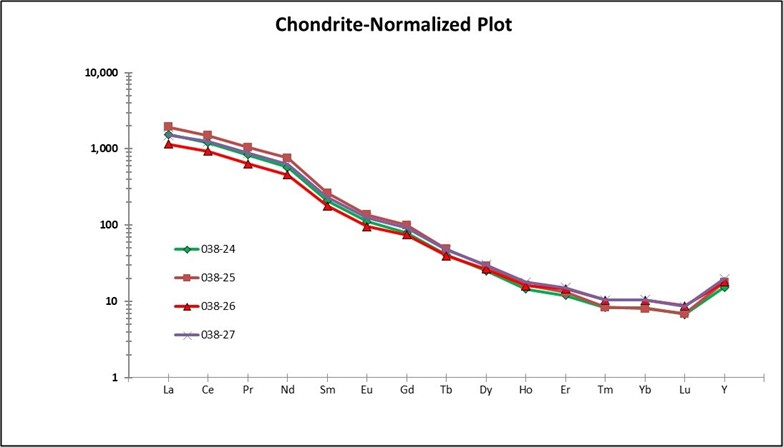
Laboratory analysis of the samples shows a geochemical fingerprint that points clearly to a deep, mantle-sourced carbonatite system. Chondrite-normalized REE plots show a smooth lanthanide distribution profile with no negative europium anomaly. This pattern is characteristic of mantle-derived alkaline magmatic systems and matches the REE signature of the Mountain Pass carbonatite. The absence of a negative europium anomaly is consistent with a deep mantle-derived REE system. This profile is exactly the profile that would be expected on the margins of a carbonatite body.
Alongside the rare earths, the samples returned elevated levels of barium, strontium, calcium, phosphorus, thorium and uranium, with associated potassium-rich alteration in the surrounding rock (see Appendix 2). This combination of elements is a well-recognized geochemical fingerprint of carbonatite systems worldwide, and mirrors the signatures documented at Mountain Pass and other major carbonatite-hosted REE deposits.
Figure 4: Chondrite Normalised Plot of the four samples collected in RC25-038 showing a smooth, lanthanide distribution profile with no negative europium anomaly, characteristic of mantle-derived alkaline magmatic systems.
RC25-038 sits on the eastern edge of Target 1, on the outer margin of the geophysical anomaly. Now that the complete combined dataset is available, it is clear that rather than testing the center of the carbonatite system, the hole grazed its edge. The main carbonatite body is believed to sit deeper and further to the east and will be drill tested accordingly.
Figure 5: REE drill hole RC25-038 in relation to IP chargeability anomaly. The hole was drilled true north and just grazed the edge of Target 1. There were pyrite rich zones at the bottom of hole, proximal to Target 1.
Lack of Oxidized Sulphur at Surface Points to Intact System That Hasn’t Leaked
At Colosseum, detailed surface sampling and review of historical data have not identified elevated sulphate or related oxyanions above Target 1. This lack of oxidized sulfur leakage is consistent with a sulfide system that remains largely intact at depth.
In practical terms, it suggests that the primary sulfide assemblage associated with the carbonatite system has not been extensively weathered nor chemically depleted over geological time. The data supports a model in which the core of the hydrothermal system remains preserved beneath cover.
For an alkaline-carbonatite setting, this is a constructive outcome. Primary rare earth mineralization in these systems is commonly associated with sulfide-bearing intrusive phases. If significant oxidation and dispersion had occurred, one would expect a broad supergene geochemical footprint at surface. The absence of such a signature reduces the likelihood that the system has been substantially “bled off” and increases the probability that the intrusion and associated sulfide-hosted REE mineralization remain preserved at depth.
When considered alongside the coincident gravity, magnetic, electrical and radiometric anomalies, and the mantle-derived REE signature in RC25-038, the geochemical stability at surface adds another line of evidence supporting the interpretation of a coherent, preserved carbonatite system. This interpretation further underpins the rationale for the planned deeper diamond drilling program targeting the interpreted core of Target 1.
Lack of Sodium Indicates Carbonate Minerals – Increases Support for Carbonatite
Additional insight has been provided from major element geochemistry, including plotting samples on a Ca-K-Na ternary diagram. The samples display negligible sodium and are strongly enriched in calcium. In the absence of sodium, the calcium is unlikely to be hosted in plagioclase or other sodic silicate minerals. Instead, the geochemical signature indicates that calcium is predominantly present within carbonate minerals. This interpretation is supported by the position of the most calcium-rich samples, which plot compositionally between dolomite and ankerite, suggesting a Mg-Fe-bearing carbonate assemblage rather than simple calcite.
This distinction is important. Carbonate minerals such as dolomite and ankerite are commonly developed in hydrothermal systems associated with alkaline and carbonatite intrusions. The identification of a dolomite-ankerite compositional trend provides geochemical support for the field observation that the rocks may represent a carbonate-rich intrusive or carbonate-dominant alteration phase.
When considered together with the absence of surface oxyanion leakage and the coincident geophysical anomalies, the carbonate-dominant chemistry is consistent with a coherent and potentially preserved intrusive system at depth, rather than superficial or surficial carbonate development.
Carbonatite Drill Program Designed
A 12-hole diamond drill program has been approved across Targets 1 and 2. The holes are designed to test both targets from multiple angles and at a range of depths, with several planned to go beyond 750 meters to reach the bodies of rock generating the geophysical signals.
At Target 1, the holes are positioned deeper and closer to the center of the system than RC25-038, following the indication from that hole that the REE-bearing rock gets wider as it goes deeper.
At Target 2, the holes are designed to test the buried body of rock identified by the gravity and electrical surveys on the eastern side of the claim, a zone that has never previously been drilled.
This press release has been authorized for release by the Board of Dateline Resources Limited.
For more information, please contact:
Stephen Baghdadi Managing Director +61 2 9375 2353
Follow Dateline on socials: X – @Dateline_DTR Truth Social – @dateline_resources LinkedIn – dateline-resources YouTube – @dateline.resources
About Dateline Resources Limited
Dateline Resources Limited (ASX:DTR)(OTCQB:DTREF)(FSE:YE1) is an Australian company focused on mining and exploration in North America. The Company owns 100% of the Colosseum Gold-REE Project in California.
The Colosseum Gold Mine is located in the Walker Lane Trend in East San Bernardino County, California. On 6 June 2024, the Company announced to the ASX that the Colosseum Gold mine has a JORC-2012 compliant Mineral Resource estimate of 27.1Mt @ 1.26g/t Au for 1.1Moz. Of the total Mineral Resource, 455koz @ 1.47/t Au (41%) are classified as Measured, 281koz @1.21g/t Au (26%) as Indicated and 364koz @ 1.10g/t Au (33%) as Inferred.
On 23 May 2025, Dateline announced that updated economics for the Colosseum Gold Project generated an NPV6.5 of US$550 million and an IRR of 61% using a gold price of US$2,900/oz.
The Colosseum is located less than 10km north of the Mountain Pass Rare Earth mine. Planning has commenced on drill testing the REE potential at Colosseum.
Dateline also owns 100% of the high-grade Argos Strontium Project, also located in San Bernardino County, California. Argos is reportedly the largest strontium deposit in the U.S. with previous celestite production grading 95%+ SrSO4.
Forward-Looking Statements
This announcement may contain “forward-looking statements” concerning Dateline Resources that are subject to risks and uncertainties. Generally, the words “will”, “may”, “should”, “continue”, “believes”, “expects”, “intends”, “anticipates” or similar expressions identify forward-looking statements. These forward-looking statements involve risks and uncertainties that could cause actual results to differ materially from those expressed in the forward-looking statements. Many of these risks and uncertainties relate to factors that are beyond Dateline Resources’ ability to control or estimate precisely, such as future market conditions, changes in regulatory environment and the behavior of other market participants. Dateline Resources cannot give any assurance that such forward-looking statements will prove to have been correct. The reader is cautioned not to place undue reliance on these forward-looking statements. Dateline Resources assumes no obligation and does not undertake any obligation to update or revise publicly any of the forward-looking statements set out herein, whether as a result of new information, future events or otherwise, except to the extent legally required.
Competent Person Statement
Sample preparation and any exploration information in this announcement is based upon work reviewed by Mr. Greg Hall who is a Chartered Professional of the Australasian Institute of Mining and Metallurgy (CP-IMM). Mr. Hall has sufficient experience that is relevant to the style of mineralization and type of deposit under consideration and to the activity which he is undertaking to qualify as a Competent Person as defined in the 2012 Edition of the “Australasian Code for Reporting Exploration Results, Mineral Resources and Ore Reserves” (JORC Code). Mr. Hall is a Non-Executive Director of Dateline Resources Limited and consents to the inclusion in the report of the matters based on this information in the form and context in which it appears.
Company Confirmations
The Company confirms it is not aware of any new information or data that materially affects the information included in the announcements dated 23 October 2024 with regard to the Colosseum MRE and 23 May 2025 with regard to Colosseum Project Economics. Similarly, the Company confirms that all material assumptions and technical parameters underpinning the estimates and the forecast financial information referred to in those previous announcements continue to apply and have not materially changed.
Delivery Marks Advancement of Collaborative Deployment Efforts as Due Diligence Continues and Infrastructure Planning Progresses
HOUSTON, TX / ACCESS Newswire / February 25, 2026 / Envirotech Vehicles, Inc. (NASDAQ:EVTV) (“EVTV” or the “Company”) today announced that it has accepted delivery of initial high-performance compute systems from AZIO AI Corporation (“AZIO AI”) in South Texas. The systems are scheduled for installation, commissioning, and integration into the Company’s modular artificial intelligence (“AI”) infrastructure platform as the parties continue to work collaboratively under their previously announced strategic framework and ongoing due diligence process.
The Company expects installation and commissioning procedures to begin shortly, followed by staged integration of compute capacity. Any digital asset production or AI workload monetization would occur only after full installation, calibration, treasury charging, and live system integration.
EVTV management believes that accepting delivery of the compute systems represents a tangible step forward in the collaborative deployment process between EVTV and AZIO AI. The South Texas location is intended to serve as an initial installation site within a broader modular AI infrastructure planning strategy.
Operational Deployment Plan
Installation of high-performance compute systems at the South Texas site
Commissioning and calibration of hardware and supporting infrastructure
Integration of compute capacity into modular data center architecture
Evaluation of staged expansion aligned with hardware throughput and infrastructure readiness
The parties continue to work side-by-side as due diligence progresses. No assurances can be made regarding the completion of any potential transaction or the timing thereof.
Scalable Infrastructure Planning: Five-Site Expansion Discussions In parallel with installation planning in South Texas, EVTV continues to advance infrastructure evaluation efforts designed to support a phased modular AI deployment strategy. The Company is engaged in preliminary site discussions, including non-binding Letters of Intent (LOIs), related to up to five additional potential data center locations, subject to installation progress, commissioning results, ongoing due diligence, and definitive agreements.
Energy-advantaged sourcing considerations
Standardized installation and commissioning sequencing
Modular containerized infrastructure architecture
Deployment pacing aligned with hardware integration and infrastructure readiness
While future expansion remains subject to successful installation and integration outcomes, EVTV management believes disciplined sequencing in South Texas provides a structured foundation for scalable infrastructure planning.
Energy Economics and Strategic Positioning EVTV’s infrastructure strategy incorporates power sourcing considerations, modular deployment design, and staged capacity integration. Management believes that maintaining disciplined progression through delivery, installation, commissioning, and integration phases is essential to supporting long-term infrastructure scalability and operational readiness.
“Power is the backbone of this business,” said Elgin Tracy, Chief Operating Officer of EVTV. “As we proceed with installation and integration in South Texas, maintaining disciplined infrastructure sequencing and energy alignment remains central to our long-term strategy.”
Strategic Context EVTV is concurrently advancing discussions related to additional potential deployment locations intended to support modular AI infrastructure expansion. These discussions remain subject to ongoing evaluation, site selection, installation outcomes, and definitive agreements.
About Envirotech Vehicles, Inc. Envirotech Vehicles, Inc. (NASDAQ:EVTV) is a technology-focused company pursuing strategic initiatives designed to enhance long-term shareholder value through platform transformation, operational realignment, and selective acquisitions.
About AZIO AI AZIO AI is a next-generation artificial intelligence infrastructure company focused on scalable, power-efficient AI data centers and mission-critical compute solutions.
Forward-Looking Statements This press release contains certain “forward‑looking statements” within the meaning of the United States Private Securities Litigation Reform Act of 1995. These statements can be identified by the use of words such as “may,” “could,” “will,” “should,” “would,” “expect,” “plan,” “intend,” “anticipate,” “believe,” “estimate,” “predict,” “potential,” “project” or “continue” or the negative of these terms or other comparable terminology. These forward-looking statements (including, without limitation, the Company’s successful deployment of the AI data center containers, the performance of immersion-cooled AI infrastructure in demanding and non-traditional environments, the parties’ ability to expand capacity and to locate appropriate sites on favorable terms for such expansion and the target for steady-state operations) are not guarantees of future performance and involve risks, assumptions, and uncertainties, including, but not limited to, risks related to the successful execution of AI infrastructure program, risks related to the development of AI data infrastructure markets, risks associated with large-scale data infrastructure projects including risks from permitting delays, electrical grid capacity limitations, zoning oppositions, supply chain disruptions, weather events, and contractor performance issues that could significantly impact project timelines and budgets, the rapid evolution of AI and data infrastructure models, and the risks and uncertainties disclosed in reports filed by EVTV with the U.S. Securities and Exchange Commission, all of which are available online at www.sec.gov. Should one or more of these risks or uncertainties materialize, or should underlying assumptions prove incorrect, actual results may vary materially from those indicated or anticipated by these forward-looking statements. Therefore, you should not rely on any of these forward-looking statements.
Readers are cautioned not to place undue reliance on these forward-looking statements, which speak only as of the date hereof. Except as required by law, EVTV undertakes no obligation to update or revise any forward-looking statements to reflect new information, changed circumstances, or unanticipated events.
Post-purchase integration drives up to 30% higher customer basket size without changing checkout flows.
NEW YORK, NY / ACCESS Newswire / February 25, 2026 / Burst (formerly Float), the healthcare payments platform that helps retailers and wellness brands unlock billions in untapped FSA and HSA spending, today announced it has raised $3 million in total funding, including a $2.1 million seed round led by Pear VC with participation from Rock Health Capital, Alumni Ventures, and others. The capital will accelerate product development and fuel partnerships with retailers, e-commerce brands, and plan administrators looking to capture more health spending.
Burst’s platform has already demonstrated strong traction with wellness brands and retail partners, driving up to 30% higher customer basket size and up to 42% increase in retention rates. The company is on a mission to make it effortless for shoppers to use their pre-tax healthcare dollars on eligible purchases while keeping checkout simple.
“We can help activate more of your customers to look like your best segment,” said Anthony Rangel, co-founder and CEO at Burst. “HSA and FSA cardholders are already retailers’ most loyal customers, returning often and spending more when they do. We eliminate the friction and empower consumers to use their pre-tax health benefits at your storefront.”
Unlike traditional FSA/HSA payment solutions that require new payment methods or checkout modifications, Burst works entirely post-purchase. Retailers keep their existing payment stack, checkout flows, and tooling. Shoppers pay as they normally would with Apple Pay, credit cards, or loyalty rewards. After purchase, Burst identifies HSA/FSA-eligible items, notifies customers of their savings opportunity, and files reimbursement claims automatically with their plan administrator.
The platform integrates through a simple Shopify app or API and works across every sales channel, including e-commerce, in-store POS systems, telehealth platforms, and subscription services. For subscriptions, Burst supports Letter of Medical Necessity (LMN) issuance and helps enable automatic recurring reimbursements, turning one-time purchases into long-term customers.
“Every attempt we’ve seen to unlock HSA and FSA spend requires merchants to change how they sell and customers to change how they buy,” said Ajay Kamat, Partner at Pear VC. “Burst flips that model by fitting into existing systems-turning reimbursement into an asset for retailers and making it effortless for customers to use their HSA and FSA funds. That’s what makes the platform scalable and gives it the potential to reshape how health spending actually flows.”
Industry data shows account holders collectively forfeit approximately $4.5 billion in FSA funds annually, with nearly half losing an average of $422 each due to complexity and missed deadlines. For pharmacies, grocery stores, and wellness brands selling eligible products like OTC medicine, supplements, fitness equipment, and wellness teas, Burst eliminates these barriers while staying fully compliant with IRS guidelines and major third-party administrators.
“The FSA and HSA world has been historically fragmented and purposefully difficult to navigate,” said Shubhi Jain, co-founder & Chief Product Officer at Burst. “We’re building the abstraction layer that makes these accounts actually work for people, becoming the center of their health and wellness spending without them having to think about it.”
Burst handles compliance and eligibility determination at the SKU level, aligned with IRS 213(d) requirements. The platform facilitates clinician-issued Letters of Medical Necessity and automatically files claims with major TPAs. Merchants get paid immediately through their normal payment stack, while customers benefit from automated claim filing and faster reimbursements-turning what was once a weeks-long manual process into an instant, seamless experience.
Burst is actively hiring across engineering and partnerships and welcomes inquiries from retailers and wellness brands. To learn more, visit getburst.com.
ABOUT BURST:
Burst (formerly Float) is a fintech platform that helps retailers and DTC wellness brands capture billions in HSA and FSA spending. Through seamless post-purchase integration and automated claims workflows, Burst enables shoppers to use pre-tax health benefits while helping merchants drive higher conversion, retention, and customer lifetime value. Learn more at https://www.getburst.com/.
Motivational Author Inks Deal With Independent Publisher
WASHINGTON, D.C. / ACCESS Newswire / February 25, 2026 / JW Radford, entrepreneur, bestselling author, and leadership strategist, has officially signed a three-book publishing deal with Poppy Grace Publishing, marking a significant milestone in his expanding literary and motivational platform.
The multi-book agreement builds on the success and impact of Radford’s work in personal development, leadership, resilience, and purpose-driven success. The forthcoming titles will expand on themes of discipline, mindset, legacy, and overcoming adversity-principles rooted in Radford’s lived experiences as a business leader, mentor, and author.
“This partnership represents more than a publishing deal-it’s a shared mission,” said Radford. “Poppy Grace Publishing understands the responsibility that comes with telling stories that don’t just motivate, but equip people to change the trajectory of their lives.”
The Founder and Publisher of Poppy Grace Publishing echoed that sentiment, emphasizing the alignment between Radford’s message and the publisher’s vision.
“JW Radford brings a rare combination of authenticity, leadership credibility, and emotional honesty to his writing,” said the Founder of Poppy Grace Publishing. “His voice speaks directly to readers who are navigating real challenges and looking for practical wisdom, not platitudes. We are honored to partner with him on this three-book journey and are confident his work will leave a lasting impact.”
Radford is the Founder and CEO of Trust Consulting Services. Beyond business, he is a sought-after speaker and mentor committed to empowering individuals to rediscover purpose, take ownership of their decisions, and pursue success without limits.
The first title under the new agreement is expected to be released at the end of February, with additional books to follow as part of the multi-year collaboration.
About JW Radford JW Radford is an entrepreneur, author, and motivational leader dedicated to helping individuals unlock their full potential. Through writing, speaking engagements, and mentorship initiatives, he challenges people to lead with intention, discipline, and purpose while building success that creates a lasting legacy.
About Poppy Grace Publishing Poppy Grace Publishing was founded in 2023 with a simple but powerful mission: to help authors turn their writing dreams into reality. As an independent publishing company, Poppy Grace Publishing is committed to elevating powerful voices and publishing impactful stories that inspire growth, resilience, and meaningful change.
Ceramics and High-Temperature Processing Expert Dr. William M. Carty, Ph.D., Engaged to Lead Ferroboron Trial
Targets Supplying Magnet-Grade Ferroboron to Potential Customers for Initial Qualification in First Half of 2026
HESPERIA, CA / ACCESS Newswire / February 25, 2026 / 5E Advanced Materials, Inc. (“5E” or the “Company”) (NASDAQ:FEAM)(ASX:5EA), a company focused on becoming a vertically integrated global leader and supplier of refined borates and advanced boron derivative materials, today announced it has commenced trials to evaluate production of magnet-grade ferroboron. As part of this initiative, the Company has engaged Dr. William M. Carty, Ph.D., to lead the ferroboron trials and support its efforts to qualify the material with potential customers.
Ferroboron is a ferrous iron-boron alloy used to introduce boron into specialty steel, and it can also serve as a boron source in the production of neodymium-iron-boron (NdFeB) permanent magnet alloys. The United States does not currently produce ferroboron domestically, creating a critical import dependency within specialty steel and permanent magnet supply chains.
5E has identified two redox-based (reduction-oxidation) process routes to trial ferroboron production in a laboratory environment. The program leverages 5E’s planned domestic boric acid production as a secure upstream feedstock, reinforcing the Company’s downstream derivative strategy. The Company intends to provide initial samples meeting specifications to prospective end users across specialty steel and NdFeB permanent magnet supply chains for evaluation and initial qualification in the first half of 2026. Program deliverables are expected to include product chemistry, impurity profiling, and particle size distribution, as well as preliminary mass and energy balances designed to inform early-stage process design and initial economic assessment.
Key Takeaways:
Dr. Carty brings deep expertise in ceramic powder processing and forming, high-temperature processes, powder characterization, and statistical analysis.
His experience includes high-temperature compatibility of oxides, carbides, nitrides, and borides, and developing robust high-temperature solutions for high-performance materials.
Two redox-based technology pathways have been selected for laboratory evaluation; the Company is targeting delivery of initial samples to prospective end users across specialty steel and permanent magnet supply chains.
Expected deliverables include material and energy balances to support early-stage processing and economic evaluation, leveraging 5E’s planned domestic boric acid production.
“This program represents the strategic next step toward establishing a secure, domestic supply chain of ferroboron,” said Paul Weibel, Chief Executive Officer. “We are pleased to engage Dr. William M. Carty in leading this initiative, bringing his expertise to support the development and evaluation of initial material for potential customers. By generating critical technical data and advancing early customer qualifications, we are positioning 5E to accelerate scale-up and capture strategic opportunities in the U.S. specialty steel and permanent magnet supply chains.”
NdFeB permanent magnets are essential components in high-efficiency electric motors, wind turbines, industrial automation, and defense systems. Global demand for NdFeB magnets is expected to grow significantly over the next decade, driven by electrification, renewable energy expansion, and advanced defense systems. Global magnet supply chains remain highly concentrated, and recent export controls and geopolitical friction have reinforced investors and customers to focus on resilient, domestic magnet supply chains. This initiative reflects 5E’s strategy to expand beyond first derivative borates into higher-value performance materials, which may enhance long-term revenue mix, strategic relevance, and customer integration.
Professional Notes: Dr. William M. Carty, Ph.D.
Dr. Carty is serving as the Company’s engaged expert in connection with the Company’s ferroboron trial program. Dr. Carty is Professor Emeritus of Ceramic Engineering at Alfred University, where he taught from 1993 to 2020. He relocated to New Hampshire in 2022 and currently serves as Chief Technology Officer for Materials Research Furnaces in Allenstown, New Hampshire. He also consults across the ceramic industry, with specialization in powder processing and forming (traditional and advanced ceramics and composites), pyrolysis and sintering processes, microstructure evolution, high-temperature chemical reactions, mechanical behavior of ceramics and composites, powder characterization, and statistical analysis. His research interests include high-temperature compatibility of oxides, carbides, nitrides, and borides, and the development of robust high-temperature solutions for high-performance materials.
About 5E Advanced Materials, Inc.
5E Advanced Materials, Inc. (NASDAQ:FEAM) (ASX:5EA) is focused on becoming a vertically integrated global leader and supplier of refined borates and advanced boron materials, complemented by calcium-based co-products, and potentially other by-products such as lithium carbonate. The Company’s mission is to become a supplier of these critical materials to industries addressing global decarbonization, energy independence, food, national security, and the defense sector. The Company believes factors such as government regulation and incentives focused on domestic manufacturing and supply chains and capital investments across industries will drive demand for end-use applications like solar and wind energy infrastructure, neodymium-ferro-boron magnets, defense applications, lithium-ion batteries, and other critical material applications. The business is based on the Company’s large domestic boron resource, which is located in Southern California and designated as Critical Infrastructure by the U.S. Department of Homeland Security, and boron was included on the U.S. Government’s 2025 List of Critical Minerals.
Forward-Looking Statements
Statements in this press release may contain “forward-looking statements” that are subject to substantial risks and uncertainties. Forward-looking statements contained in this press release may be identified by the use of words such as “may,” “will,” “should,” “expect,” “plan,” “anticipate,” “could,” “intend,” “target,” “project,” “contemplate,” “believe,” “estimate,” “predict,” “potential” or “continue” or the negative of these terms or other similar expressions, and include, but are not limited to, statements regarding the Company’s ferroboron trial program; the timing and results of the ferroboron trials; the ability to produce ferroboron at acceptable cost, scale and quality; development plans; production capabilities; commercialization strategy; ability to negotiate or obtain offtake agreements; customer qualification processes for any of its proposed products, and success thereof; market demand for boron, lithium and ferroboron; the potential applications of its products across energy, defense, agriculture and industrial markets; and ability to access and secure any government-based financing. Any forward-looking statements are based on 5E’s current expectations, forecasts, and assumptions and are subject to a number of risks and uncertainties that could cause actual outcomes and results to differ materially and adversely from those set forth in or implied by such forward-looking statements. These risks and uncertainties include, but are not limited to, statements regarding the Company’s ferroboron trial program; the timing and results of the ferroboron trials; the ability to produce ferroboron at acceptable cost, scale and quality; development plans; production capabilities; commercialization strategy; ability to negotiate or obtain offtake agreements; customer qualification processes for any of its proposed products, and success thereof; market demand for boron, lithium and ferroboron; the potential applications of its products across energy, defense, and industrial markets; and ability to access and secure any government-based financing. For a discussion of other risks and uncertainties, and other important factors, any of which could cause our actual results to differ from those contained in the forward-looking statements, see the section entitled “Risk Factors” in 5E’s most recent Annual Report on Form 10-K and its other reports filed with the SEC. Forward-looking statements contained in this announcement are based on information available to 5E as of the date hereof and are made only as of the date of this release. 5E undertakes no obligation to update such information except as required under applicable law. These forward-looking statements should not be relied upon as representing 5E’s views as of any date subsequent to the date of this press release. In light of the foregoing, investors are urged not to rely on any forward-looking statement in reaching any conclusion or making any investment decision about any securities of 5E.
A candid conversation with the President & CEO of Sky Property Group Inc. on grit, vision, and what it truly takes to lead in one of Canada’s most demanding industries.
TORONTO, ONTARIO / ACCESS Newswire / February 25, 2026 / She arrives precisely on time – a detail that feels less like habit and more like a statement. Ladan Hosseinzadeh Sadeghi, President & CEO of Sky Property Group Inc., has built her career in one of Toronto’s most competitive arenas: large-scale land assembly and high-rise development across the Greater Toronto Area. But her path here began somewhere entirely different – at a hospital bedside, in a nurse’s uniform.
We sat down with Ladan to talk about the journey, the walls she had to push through, and what she believes the future holds for women in Canadian real estate.
—
Q: You started your career as a registered nurse. That’s a significant pivot to real estate development. What made you make that leap?
A: Nursing shaped me more than I realized at the time. It taught me discipline, it taught me how to read a room – how to read people – and it showed me what it means to work under pressure when the stakes are genuinely high. When I transitioned to real estate in the early 1990s, I wasn’t leaving that training behind. I was taking it with me.
The leap felt significant from the outside, but from the inside it was more of a slow pull. I had always been drawn to building things, to creating something that lasts. Real estate, especially development at the scale I was interested in, felt like the highest-order version of that. You’re not just buying and selling – you’re reshaping communities. That was compelling to me.
—
Q: The early 1990s in Toronto was a difficult time to enter real estate, never mind as a woman. What was that environment like?
A: Honest answer? It was hard. The industry was – and in many ways still is – dominated by men, and there was a very particular culture around who got taken seriously, who got the calls returned, who was invited into the room. I was a woman, I was an immigrant, and I was new to the industry. That’s three strikes before you’ve said a word.
But here’s what I learned early: you can spend your energy resenting the room, or you can spend it outworking the room. I chose the latter. I made myself impossible to ignore by simply knowing more, preparing more, and delivering more than anyone expected. That’s not a comfortable answer – it puts the burden on the person who’s already disadvantaged – but it was my reality, and it worked.
—
Q: Were there specific moments where you felt that bias most acutely?
A: Of course. There were deals where I’d walk into a negotiation and watch the other side direct every comment to my male colleague, even when I was the decision-maker. There were lenders and partners who needed to be convinced – not of the deal, but of me. It gets exhausting.
What I remind myself, and what I tell younger women, is that every time you close a deal in that environment, you make the next one easier. Not just for yourself, but for the woman who comes after you. You’re changing the data set. When I eventually had enough of a track record that the skepticism faded, it felt like a collective win, not just a personal one.
—
Q: Sky Property Group has grown into a major force in GTA land assembly and high-rise development. How do you describe what the company actually does for people who aren’t in the industry?
A: We find land – often multiple adjacent properties that need to be assembled into a single parcel – and we create the conditions for significant vertical development. In a city like Toronto, where the pressure for housing is extraordinary and the available land is scarce, that work is genuinely critical. We’re not filling a market gap; we’re helping create the supply that the city desperately needs.
At any given time, we have multiple projects in various stages – from initial assembly and zoning work through to working with development partners to see towers rise. It’s a long game. Some of these projects span a decade from first acquisition to completion. You have to love the process, not just the outcome.
—
Q: What advice do you give to women who are trying to build careers – or companies – in real estate today?
A: Three things. First, get fluent in the numbers. Not just financially literate – fluent. You need to be able to walk into any room and command the financial conversation. That’s where credibility lives in this industry, and no one can take it away from you once you have it.
Second, build relationships before you need them. This business runs on trust and connections, and those things take years to develop. Start now, even if you don’t see an immediate return.
Third – and this one might sound unusual – stay humble about what you don’t know. The best deals I’ve ever passed on were the ones I recognized early as being beyond my expertise at that moment. Arrogance is expensive in real estate.
—
Q: What does the landscape look like for women in real estate leadership today versus when you started?
A: It’s better. Genuinely better. I see women in senior positions at developers, at lenders, at planning departments. The pipeline is broader. But we haven’t solved it – not even close. At the C-suite level, at the ownership level, in the rooms where the really large decisions get made, the imbalance is still significant.
What I hope Sky Property Group represents, among other things, is proof of concept. That a woman-led company can operate at this scale, in this market, and do it well. If that changes one investor’s assumption or opens one door for one young woman, then it matters.
—
Q: What’s your vision for Sky Property Group over the next decade?
A: Continued growth in the GTA, with a sharper focus on transit-connected corridors where density makes the most sense for the communities we’re building in. We’ve also expanded internationally – we have a presence in Dubai now, which has been a fascinating chapter – and I see that growing as well.
But the bigger vision is really about legacy. I want Sky Property Group to be the kind of company that’s known not just for what it built, but for how it built – with integrity, with care for the communities affected, and with a team that reflects the diversity of the city we work in.