5 Costly Contractor Lien Mistakes in Texas (& How to Avoid Them)
Austin, United States – March 24, 2026 / Texas Easy Lien /
Key Takeways
Most Texas contractors lose their lien rights because of preventable filing mistakes, not because they lack a valid claim.
-
Missing deadlines by even one day permanently forfeits your right to file a lien and recover payment.
-
Skipping required pre-lien notices is the single most common contractor lien mistake in Texas for subcontractors and suppliers.
-
Using a street address instead of the legal property description can invalidate an otherwise airtight lien claim.
-
Filing under the wrong contractor tier or forgetting the 5-day post-filing notice can unravel months of careful compliance.
If you’re working in Texas construction and haven’t reviewed your lien filing process recently, one of these five mistakes could be costing you thousands.
Texas lien laws are some of the strictest in the country. They give contractors, subcontractors, and suppliers a powerful tool for recovering unpaid work, but they also punish even small errors with total loss of lien rights. According to Rabbet’s 2024 Construction Payments Report, slow payments cost the U.S. construction industry an estimated $280 billion in 2024, and 82% of contractors reported waiting more than 30 days for payment. Those numbers make the mechanic’s lien one of the most important payment protection tools available. Yet many contractors file liens incorrectly, or miss their window entirely, because of avoidable mistakes.
This guide breaks down the five most common contractor lien mistakes in Texas and explains how to avoid each one.
What Makes Contractor Lien Mistakes in Texas So Expensive?
Texas mechanic’s lien law, governed by Chapter 53 of the Texas Property Code, offers no leniency for procedural errors. Miss a deadline, skip a required notice, or include incorrect property information, and your lien claim can be thrown out entirely regardless of how justified your claim is.
What makes these lien pitfalls particularly frustrating is that most stem from confusion about the rules, not willful neglect. Texas uses different deadlines for original contractors versus subcontractors, different timelines for commercial versus residential projects, and specific notice requirements that change depending on your position in the contract chain. That complexity is where mistakes happen, but every one of these common lien filing errors in TX is preventable once you understand what to watch for.
The 5 Most Common Contractor Lien Mistakes in Texas
Mistake #1: Missing Critical Lien Deadlines
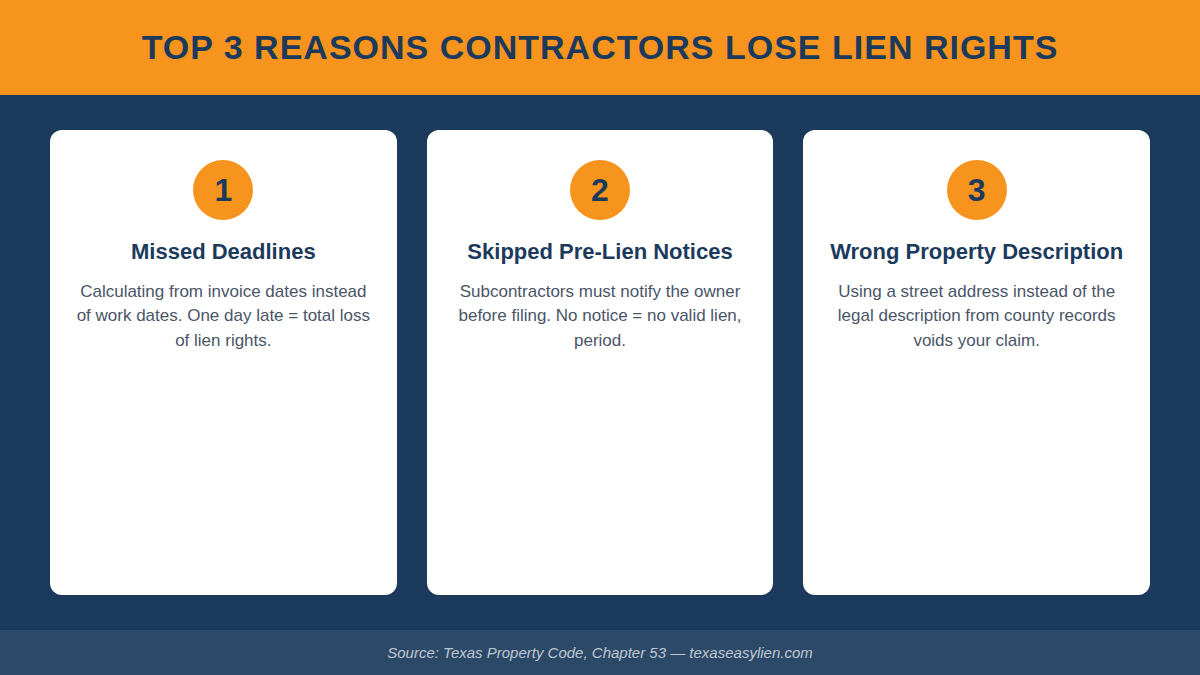
Deadline miscalculation is the most common contractor lien mistake in Texas, and it’s almost always fatal to the claim. As construction attorneys at Cokinos | Young have noted, many contractors miscalculate their deadlines because they base them on invoice dates rather than the dates work was actually performed. The statute ignores your billing schedule entirely.
Here’s how the deadlines break down under current Texas law:
For Original (General) Contractors:
-
Commercial projects: File the lien affidavit by the 15th day of the fourth month after the contract is completed, terminated, or abandoned.
-
Residential projects: File by the 15th day of the third month after completion.
For Subcontractors and Suppliers (Commercial):
-
Pre-lien notice: By the 15th day of the third month after performing unpaid work.
-
Lien affidavit: By the 15th day of the fourth month after performing unpaid work.
For Subcontractors and Suppliers (Residential):
-
Pre-lien notice: By the 15th day of the second month after performing unpaid work.
-
Lien affidavit: By the 15th day of the third month after performing unpaid work.
One important update: Senate Bill 929, signed into law May 21, 2025, clarifies that when any deadline falls on a Saturday, Sunday, or legal holiday, it automatically extends to the next business day.
How to avoid it: Track deadlines from the last date you actually performed work each month, not from your invoice date. Set calendar reminders well ahead of each deadline so you have time to prepare and file without rushing.
Mistake #2: Skipping the Required Pre-Lien Notice
If you’re a subcontractor, sub-subcontractor, or material supplier without a direct contract with the property owner, you must send a pre-lien notice before filing a mechanic’s lien. Original contractors are exempt, but everyone else must comply.
This is one of the most common lien filing errors in TX because many subcontractors assume they can file a lien the same way a general contractor does. They can’t. Without a properly sent pre-lien notice, your lien affidavit is invalid, even if it’s filed on time with perfect information.
Here’s the encouraging part: sending a pre-lien notice is often enough to resolve the payment issue by itself. Once the property owner and general contractor know you’re serious about pursuing your lien rights, payment frequently follows.
How to avoid it: Send your pre-lien notice as soon as you identify a payment problem. The notice must be mailed using certified mail, registered mail, or another traceable delivery method that confirms proof of receipt.
Mistake #3: Using Incorrect Property Descriptions
This contractor lien mistake in Texas might seem minor, but it’s one property owners’ attorneys actively look for when challenging claims. Texas law requires a legally sufficient description of the property in your lien affidavit, meaning the full legal description from county property records. Lot numbers, block numbers, subdivision names, and survey references are required. A street address from your contract is not enough.
Getting the property owner’s identity correct matters equally. The individual or entity listed on your lien must match the actual property owner, not the person who hired you and not a tenant or related company.
How to avoid it: Research the legal property description and ownership information at the beginning of each project so you’re prepared if a payment problem develops. Many online lien filing platforms include built-in property verification tools that help you confirm this information before filing.

Mistake #4: Filing Under the Wrong Contractor Tier
Texas lien law imposes different requirements based on your position in the contract chain. The three tiers are:
-
Original Contractor (Tier 1): Direct contract with the property owner. No pre-lien notice required.
-
Subcontractor (Tier 2): Contracts with the original contractor. Must send pre-lien notices and follow subcontractor deadlines.
-
Sub-subcontractor (Tier 3): Contracts with a subcontractor. Same requirements as Tier 2, plus must include names and addresses of all subcontractors above them.
Confusion typically arises when a contractor believes they’re dealing with the property owner, but that person is actually a tenant or project manager. House Bill 2237, effective January 2022, simplified the process by aligning first-tier and second-tier subcontractor requirements with the same standardized notice forms and timeline structure.
How to avoid it: Before starting any project, confirm who the actual property owner is and verify your position in the contract chain.

Mistake #5: Forgetting the Post-Filing Notice Requirement
This is the lien pitfall that catches even experienced contractors off guard. After you file your lien affidavit with the county clerk, Texas law requires you to send a copy of the filed lien to the property owner and the original contractor within five calendar days.
Many contractors assume the process is complete once the lien is filed. It’s not. Failing to send copies within that five-day window can render your lien unenforceable.
How to avoid it: Build the five-day post-filing notice into your process as a standard step. The moment your lien is filed, immediately prepare and mail copies via certified mail to all required parties.
Quick Checklist to Avoid Common Lien Filing Errors in TX
Use this checklist at the start of every project to protect your lien rights from day one:
-
Gather project information early. Collect the property owner’s legal name, the full legal property description, the general contractor’s name and address, and the county where the project is located.
-
Know your contractor tier. Confirm whether you’re an original contractor, subcontractor, or sub-subcontractor.
-
Track deadlines from work dates, not invoice dates. Calculate all deadlines based on the last day of each month you performed work.
-
Send pre-lien notices promptly. If you’re a subcontractor or supplier, send notices as soon as a payment problem develops.
-
Use traceable delivery methods. Send all notices via certified mail or another method that provides proof of receipt.
-
Verify property descriptions through county records. Never rely on the street address from your contract alone.
-
Mail post-filing copies within five days. After filing your lien affidavit, send copies to the owner and general contractor immediately.
Frequently Asked Questions
Can I fix a mistake on a lien affidavit after it’s been filed?
It depends on the error type and whether your filing deadline has passed. You may be able to file an amended affidavit before the original deadline expires, but once that deadline lapses, you may lose the ability to refile. Accuracy during the initial filing is critical.
Do original contractors need to send a pre-lien notice in Texas?
No. Original contractors with a direct contract with the property owner are not required to send pre-lien notices. However, they must still send a copy of the filed lien affidavit to the owner within five days of filing. On homestead properties, additional requirements apply, including the need for a written contract.
What’s the difference between commercial and residential lien deadlines?
Residential projects (where the owner actually lives) have shorter deadlines than commercial projects. Subcontractors on residential projects must send pre-lien notices by the 15th of the second month after unpaid work (versus the third month for commercial) and file lien affidavits by the 15th of the third month (versus the fourth month for commercial). Spec homes and investment properties are generally classified as commercial.
How to Protect Your Lien Rights Going Forward
Avoiding these costly lien mistakes comes down to preparation and consistency. Without a valid lien, you lose the leverage that pressures property owners to pay, and you’re left chasing payment through more expensive legal channels. The contractors who protect their payment rights are the ones who build lien compliance into their standard operating procedures rather than scrambling when a payment problem arises.
Stay current on legal changes. The 2022 reforms under HB 2237 simplified many notice requirements, and SB 929 in 2025 resolved longstanding confusion about weekend and holiday deadlines. These changes benefit contractors, but only if you know about them and adjust accordingly.
Consider using a digital filing platform that guides you through the process and helps you avoid common lien filing errors in TX. The right platform can verify property information, calculate deadlines automatically, and ensure your documents meet all legal requirements before you file.
Getting paid for your work shouldn’t require a law degree. Texas Easy Lien helps contractors, subcontractors, and suppliers prepare, notarize, file, and mail their lien documents entirely online, in about 15 minutes, and at a fraction of the cost of hiring an attorney. If you’re ready to protect your payment rights the right way, get started with Texas Easy Lien today.


Contact Information:
Texas Easy Lien
1101 S Capital of Texas Hwy Bldg G, Suite 200
Austin, TX 78746
United States
Adriana Silva
https://www.texaseasylien.com/